header picture

header picture
Showing posts with label merino. Show all posts

Sunday, January 27, 2019

Wear and Tear

Today, I'm going to look back at old projects to see how time has treated them.

But first, an update on the sweater.

The sweater is progressing. It's been a long time since I made a sweater (I've only ever made three), and it makes me remember why I prefer short projects. The time between the planning and the payoff is loooong, and there is a lot of time just doing simple stitching. Since I'm not a student anymore, and I don't do many conference calls, I don't have a lot of time when I want to be doing simple stitches. When I'm knitting on my commute I want to be entertained!

Sweater currently: no sleeves, no collar, no bottom. But top and middle are finished.
All that said, I'm pretty pleased with how it is coming out. The only thing I am worried about is that the yarn is pretty loosely plied. I knit English-style, which tends to loosen plies even further. It looks fine now, but who knows how it will wear - it's a pretty soft yarn. It's a lot of work for a sweater if it  will look awful in a year.

I've had some problems with soft yarns in the past. Here is my (award-winning) merino brioche hat when it was new in 2015:
Brioche hat in 2015
And now:
Brioche hat in 2019
 The merino wool is very soft, but it doesn't hold up to heavy wear. I've worn it for several winters, and it is pilling, stretching, and shedding. But it is still warm, and still pretty. So I'm going to keep wearing it.

This inspired me to look around to see what else I could find around the house. A couple looked pretty good, but they had stretched a bit.

My first pussy hat, made with acrylic eyelash yarn, made in 2017 and hardly worn
A slouchy beret in blue and purple, made in 2008.
One had shrunk, so that I don't really wear it anymore:

Red and blue reversible hat, newly made in January 2012.
Reversible hat in 2019: smaller (it no longer covers the tops of my ears), and pilling.
Other items were just looking worn - pilling, shedding, woven-in-ends pulling out:
Lap blanket made in 2005. You can barely see the stitches from all of the yarn halo. I have also had to resew the panels together several times.

Astronomy hat finished in early 2016.  My husband wears this a lot, so it is already pilling.

Baby blanket finished November 2017. It's not that old, but the yarn was loosely spun and slippery, so it is already showing a prominent halo of shed yarn. Woven ends are coming out too, because it is so slippery.
One scarf is made of rougher wool (coopworth) so it is not shedding or pilling. But... I made it using a slipped stitches pattern. It has curled a lot, and I don't bother trying to straighten it.
Scarf made from my first real handspun in 2014. Nice and blocked (though the yarn is uneven).
Same scarf in 2019. No pilling, but it has curled up into a tube.
Of course, all of these are survivors. We all have a tendency to lose things, even hand-knitted things (especially my husband). So, here's to a hat that has gone into the void of lost items: all we have is the picture. I hope it is keeping someone's ears warm, somewhere.
Reversible hat, finished in December 2011. Residing somewhere else in 2019.

Reversible hat, other side.
It is a nice reminder that the life of our projects is only beginning when we take them off the needles. A "finished" project is anything but.


Sunday, July 3, 2016

An Update and a Trip Report

Hello internet people!

I know that I have been lax in updating recently. It is not so much that I have been busy, I just have been mostly working on big projects, so updates are sparse.

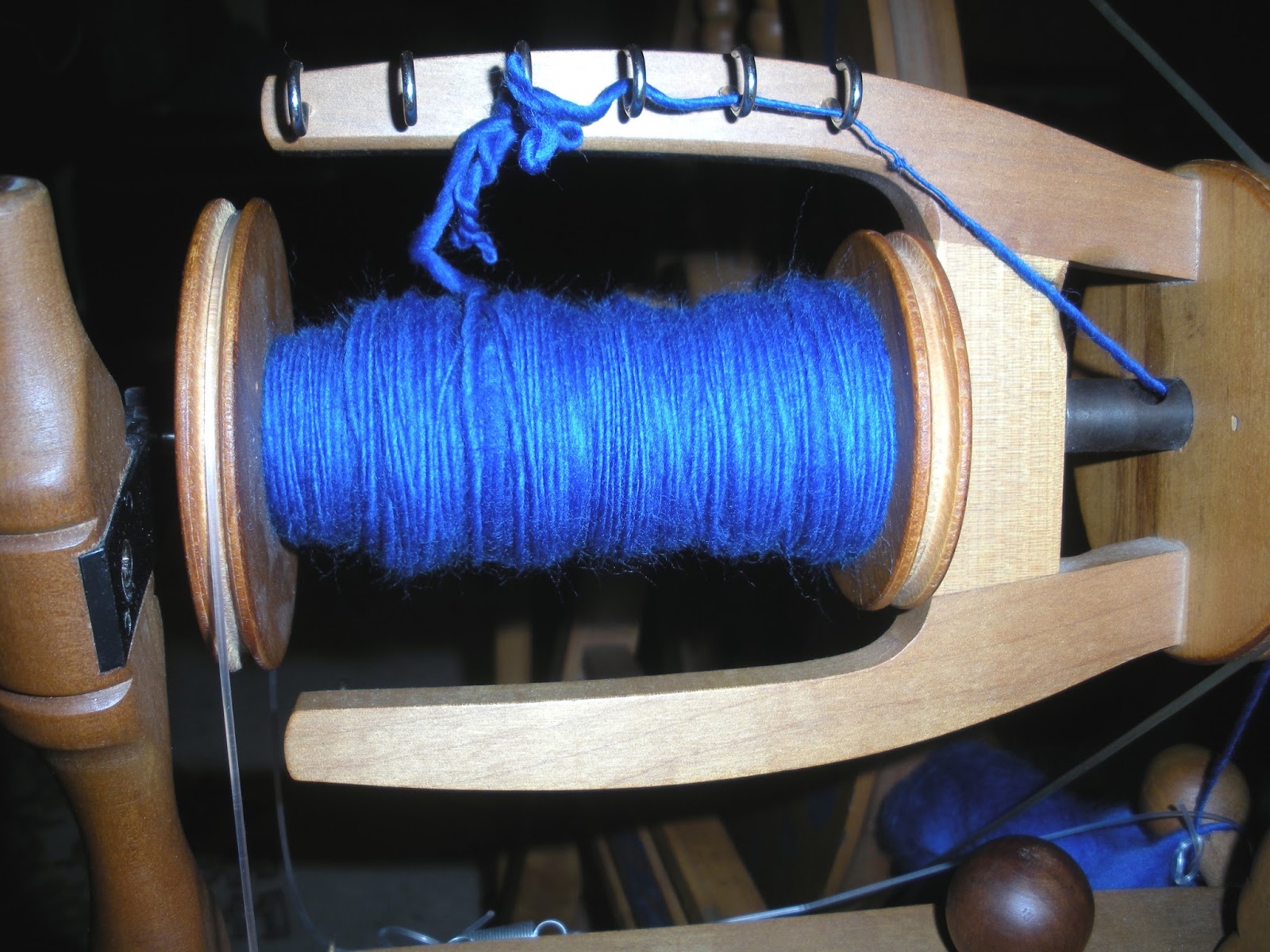
First of all, I did finish the bulky merino yarn I was working on. Definitely not my best work: There are some parts where I obviously wasn't paying attention, and the singles have far too much twist. I think I just didn't realize how important it is to have low-twist for both bulky singles and merino wool in particular. Plying forgives a lot, but not everything.
Bulky Blue Merino yarn
I have started on some matching black yarn, and I do hope that I learned something from the first try, and it will be better.
Black Merino Bulky singles on the bobbin
Progress continues on my skirt, but I don't have a good picture for you right now. I am hoping to finish it in time to enter it at the Maryland State Fair.

I also went on a trip to Virginia Beach with my husband and in-laws last weekend. We went to Antiques Roadshow! I brought my antique castle wheel, in hopes that the appraisers could tell us how old it was and who made it. Well...

It was made in the 20's or 30's. But it wasn't commercially made, so who knows where it is from. Pretty much what I was told by the person who sold it to me.

We got a bit more useful information about the other three things we brought (a ring, a vase, and a set of silver) but no huge surprises. We had fun talking to people in line though, and everyone was really interested in my wheel - some intern even filmed me talking about it. I also got some funny questions when I got bored and took out my drop spindle. All-in-all, a fun time.

Thursday, May 26, 2016

Roving and Top: Gray and Blue

Maybe it is the return of warmer weather, but I have been on a spinning kick recently. Very little knitting getting done, but plenty of spinning. Along with the  project on my spindle that I showed you last week, I have also started an easy project on my Ashford wheel.
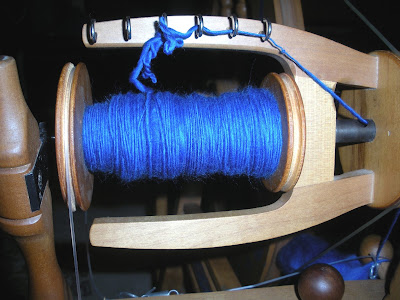
My newest project: thick merino. (The colors are totally off though)
Last year I bought some dyed merino top at Maryland Sheep and Wool festival. It was an incredibly good price, and it's one of those fibers that you have to use at least sometimes: super-duper soft and fluffy, great for garments. However, because it is so fine, it doesn't wear very well, or so I have heard.

The history of merino sheep is actually pretty neat. In the 18th and early 19th Centuries, all merinos were owned by the Spanish crown. To sell a sheep to anyone else was considered treason and the punishment was death. In the 19th Century, they gradually loosened the restrictions, and they are pretty ubiquitous today.

I haven't decided what I am going to do with this yarn yet, but it is going to be a thick two ply yarn, with one skein of blue and one of black.

Merino top from Delly's Delights Farm in Louisa, VA. This is closer to what the color actually looks like

Same as above, in black.
In other fiber news, I learned a useful skill.

Because I might be teaching more spinning in the future, I decided to get some ugly, cheap "learning" wool that I can give to students. I got two pounds of this:

4 oz. of "domestic gray wool" roving from The Woolery.
I didn't want white wool, because it is hard to see the twist, so I think this gray stuff is just about perfect. Has some neps (little bits of broken fiber) and is a bit dirty (with a very "sheepy" smell). But t is quite soft, and the color is nice, if boring.

The main question was how to store all of that wool. It came in bags, but just stuffed in there - recipe for tangles.

Some of it I wound into balls, just like I would do with yarn.
4 oz. roving ball (and Sandy, looking for attention)
But I had also seen roving braided, and wanted to try. It looks better than the ball, gets more air, and I think is a bit more compact.

The first thing to know about the braiding is that it isn't a brain, it is a crochet chain. That means that if you want to get the wool, you just have to tug, and it will come undone. The second thing to know is that I am pretty sure the other braids I have seen were only two ounces, because my braid was something like 6 feet long. It think I got the hang of it though.

What do you think?
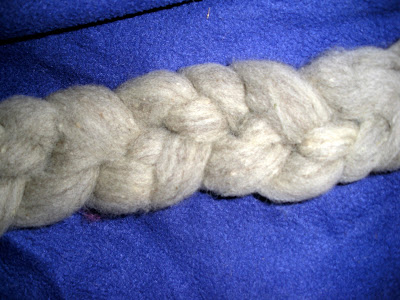
"braid" of roving: closeup.