header picture

header picture
Showing posts with label wheel spinning. Show all posts

Sunday, August 6, 2017

Woolen Spinning

 Back in April, I dyed some roving that I was not a huge fan of. I was not much of a fan of the dyed version either: that "kelly green" dye is so bright! I feel like anything I knit with it will make me look like a crossing guard.
Dyed ramboullet roving in a bowl to dry
But I didn't want to waste it. It was my first time dyeing roving. Well, what do you do with fiber you don't like very much? Experiment and practice new techniques!

And this roving is getting that treatment twice. First, dyeing practice, then a new spinning technique: long draw.

For those of you who don't know, long draw is a technique where you pull the fiber, one-handed, away from the orifice of the wheel. In short draw, where your second hand is pinching the fiber so that there is no twist in the drafting area. In long draw, the twist goes into the drafting area. But the twist will travel to the thin parts of the fiber, so pulling on it will only draft the thicker parts (this won't work with long stapled fiber, or if the fibers are aligned - like with top). In short draw, you smooth the wool with your second hand, but in long draw you let it stay "fuzzy". This will create a woolen yarn - airy, fuzzy, and warm, with poor stitch definition.

Now, of course, the spinning I'm doing can't be a "true" woolen prep if I am not using rolags from my hand carders. But this kind of narrow roving is pretty similar, and the fibers are certainly not aligned like with top. I do think that it would be easier with rolags though: this fiber was really "sticky" and hard to draft, so I couldn't do a pure long draw either - I kept needing to tug on the roving with my second hand to free it. It probably doesn't help that my wheel has very little "pull", even after tightening it quite a bit.

My final tally was over 600 yards of long draw singles, and I was definitely getting the hang of the technique by the end. So, as a practice yarn, it was a success. How did it come out as a yarn for knitting though?

300 yards 2-ply woolen ramboullet yarn
It could be a lot worse. 

Looking at the singles, there were several parts of the color that I really liked, and it might have come out better if I had left out the yellow dye. The yellow just made the neon problem in the green worse.
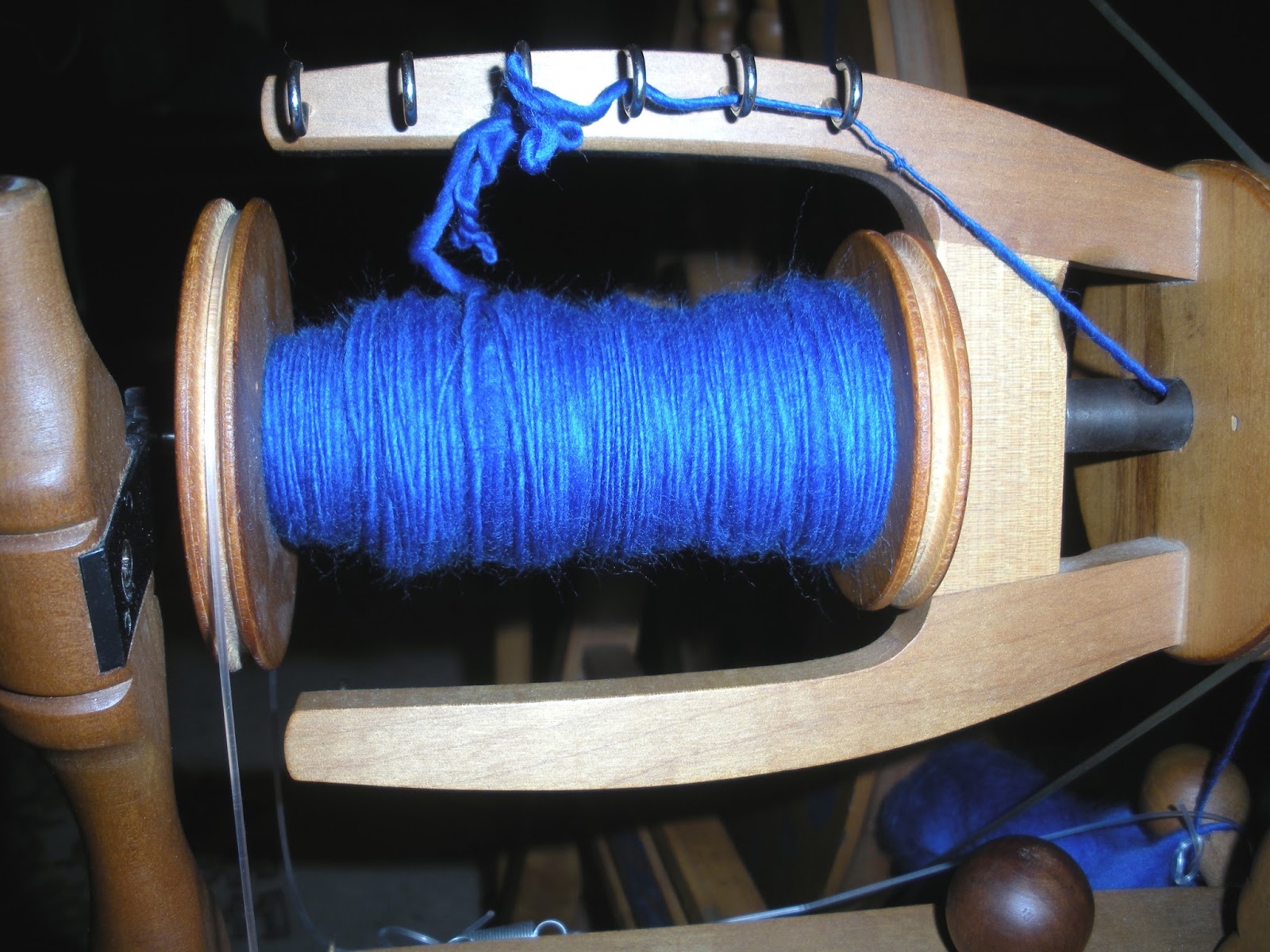
Singles on the bobbin
When I was about to ply, some of the color was so nice that I was tempted to just do an n-ply to preserve the color progression. But the yarn was pretty uneven, which would only be exacerbated by an n-ply. And I was hoping that the uglier parts of the color progression would be tamed by the prettier colors.
2 full bobbins, ready for plying
I don't know how successful that was. It is so hard to tell in the skein. I guess I'll have to wait until I knit it to see if I like the finished product.
Blending colors at the beginning of plying
The end of the second bobbin of plying


Thursday, May 26, 2016

Roving and Top: Gray and Blue

Maybe it is the return of warmer weather, but I have been on a spinning kick recently. Very little knitting getting done, but plenty of spinning. Along with the  project on my spindle that I showed you last week, I have also started an easy project on my Ashford wheel.
My newest project: thick merino. (The colors are totally off though)
Last year I bought some dyed merino top at Maryland Sheep and Wool festival. It was an incredibly good price, and it's one of those fibers that you have to use at least sometimes: super-duper soft and fluffy, great for garments. However, because it is so fine, it doesn't wear very well, or so I have heard.

The history of merino sheep is actually pretty neat. In the 18th and early 19th Centuries, all merinos were owned by the Spanish crown. To sell a sheep to anyone else was considered treason and the punishment was death. In the 19th Century, they gradually loosened the restrictions, and they are pretty ubiquitous today.

I haven't decided what I am going to do with this yarn yet, but it is going to be a thick two ply yarn, with one skein of blue and one of black.

Merino top from Delly's Delights Farm in Louisa, VA. This is closer to what the color actually looks like

Same as above, in black.
In other fiber news, I learned a useful skill.

Because I might be teaching more spinning in the future, I decided to get some ugly, cheap "learning" wool that I can give to students. I got two pounds of this:

4 oz. of "domestic gray wool" roving from The Woolery.
I didn't want white wool, because it is hard to see the twist, so I think this gray stuff is just about perfect. Has some neps (little bits of broken fiber) and is a bit dirty (with a very "sheepy" smell). But t is quite soft, and the color is nice, if boring.

The main question was how to store all of that wool. It came in bags, but just stuffed in there - recipe for tangles.

Some of it I wound into balls, just like I would do with yarn.
4 oz. roving ball (and Sandy, looking for attention)
But I had also seen roving braided, and wanted to try. It looks better than the ball, gets more air, and I think is a bit more compact.

The first thing to know about the braiding is that it isn't a brain, it is a crochet chain. That means that if you want to get the wool, you just have to tug, and it will come undone. The second thing to know is that I am pretty sure the other braids I have seen were only two ounces, because my braid was something like 6 feet long. It think I got the hang of it though.

What do you think?
"braid" of roving: closeup.